创新点:
(1)非常深的残差通道注意网络(RCAN),用于高精度的图像SR。我们的RCAN可以比以前的基于cnn的方法更深入,并获得更好的SR性能。
(2)残差到残差(residual in residual)(RIR)结构来构建非常深的可训练网络。RIR中的长、短跳连接有助于绕过丰富的低频信息,使主网络学习到更有效的信息。
(3)通道注意(CA)机制,通过考虑特征通道之间的相互依赖关系来自适应地缩放特征。这种CA机制进一步提高了网络的表征能力。
关键点:残差群RG、长跳连接LSC、短跳连接SSC、通道注意力机制CA
由于用了非常多残差连接,网络深度甚至可以达到400层。
整体结构
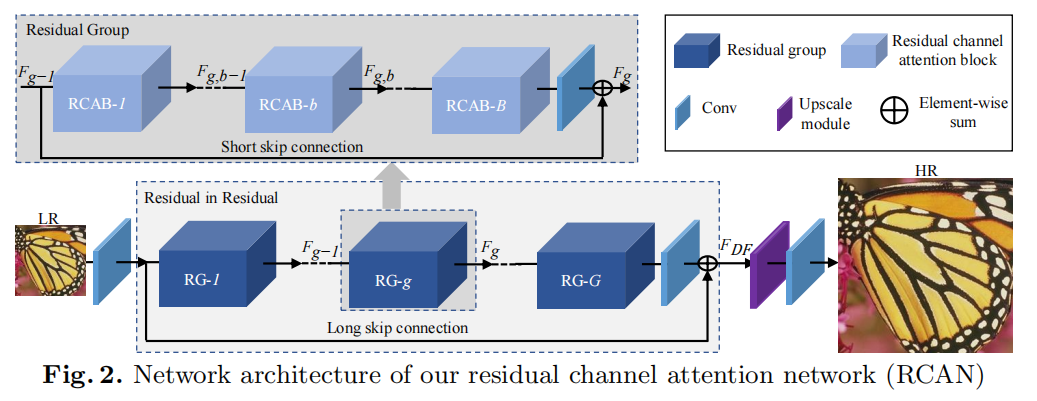
主要包括四个部分:浅层特征提取、残差(RIR)深度特征提取、上采用模块和重建部分。

WLSC表示RIR最后一个卷积层后采用的权重。
通道注意力机制CA
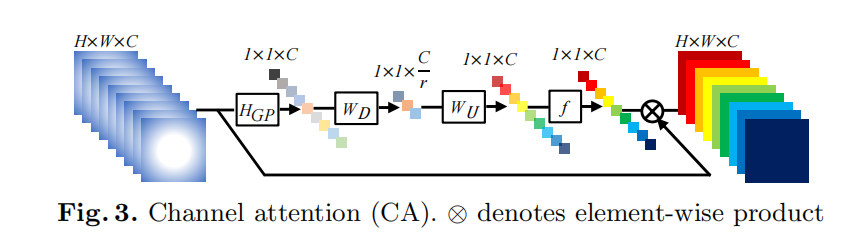
通道注意(CA)机制,通过建模特征通道之间的相互依赖关系,自适应地重新调整每个通道级特征。这样的CA机制允许我们提出的网络集中于更有用的网络。
主要步骤:利用全局平均池化方法将通道级的全局空间信息引入通道token。
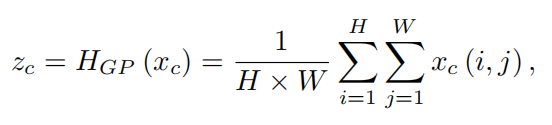

WD是卷积层的权重。
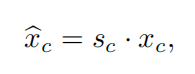
sc是缩放比例,xc是特征map。
RCAB: B个residual channel attention blocks
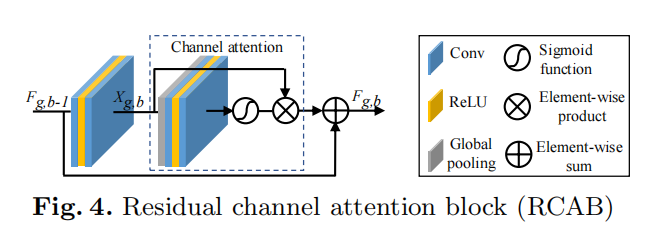
损失函数
L1范数
CODE
CA层,对应
## Channel Attention (CA) Layer
class CALayer(nn.Module):
    def __init__(self, channel, reduction=16):
        super(CALayer, self).__init__()
        # global average pooling: feature --> point
        self.avg_pool = nn.AdaptiveAvgPool2d(1)
        # feature channel downscale and upscale --> channel weight
        self.conv_du = nn.Sequential(
                nn.Conv2d(channel, channel // reduction, 1, padding=0, bias=True),
                nn.ReLU(inplace=True),
                nn.Conv2d(channel // reduction, channel, 1, padding=0, bias=True),
                nn.Sigmoid()
        )

    def forward(self, x):
        y = self.avg_pool(x)
        y = self.conv_du(y)
        return x * y
RCAB层,对应
## Residual Channel Attention Block (RCAB)
class RCAB(nn.Module):
    def __init__(
        self, conv, n_feat, kernel_size, reduction,
        bias=True, bn=False, act=nn.ReLU(True), res_scale=1):

        super(RCAB, self).__init__()
        modules_body = []
        for i in range(2):
            modules_body.append(conv(n_feat, n_feat, kernel_size, bias=bias))  # 卷积
            if bn: modules_body.append(nn.BatchNorm2d(n_feat))
            if i == 0: modules_body.append(act)          # 图4中的ReLU层
        modules_body.append(CALayer(n_feat, reduction))  # 加入CA层
        self.body = nn.Sequential(*modules_body)
        self.res_scale = res_scale

    def forward(self, x):
        res = self.body(x)
        #res = self.body(x).mul(self.res_scale)
        res += x
        return res
RG层,对应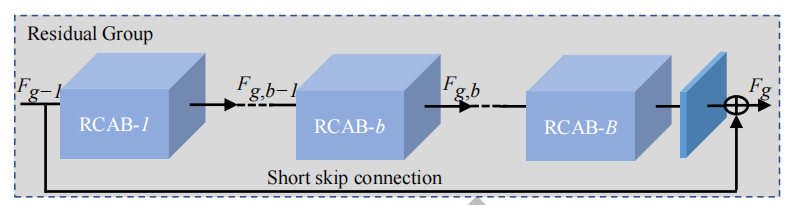
## Residual Group (RG)
class ResidualGroup(nn.Module):
    def __init__(self, conv, n_feat, kernel_size, reduction, act, res_scale, n_resblocks):
        super(ResidualGroup, self).__init__()
        modules_body = []
        modules_body = [
            RCAB(
                conv, n_feat, kernel_size, reduction, bias=True, bn=False, act=nn.ReLU(True), res_scale=1) \
            for _ in range(n_resblocks)]
        modules_body.append(conv(n_feat, n_feat, kernel_size))
        self.body = nn.Sequential(*modules_body)

    def forward(self, x):
        res = self.body(x)
        res += x
        return res
整体RCAN层

## Residual Channel Attention Network (RCAN)
class RCAN(nn.Module):
    def __init__(self, args, conv=common.default_conv):
        super(RCAN, self).__init__()

        n_resgroups = args.n_resgroups
        n_resblocks = args.n_resblocks
        n_feats = args.n_feats
        kernel_size = 3
        reduction = args.reduction
        scale = args.scale[0]
        act = nn.ReLU(True)

        # RGB mean for DIV2K
        rgb_mean = (0.4488, 0.4371, 0.4040)
        rgb_std = (1.0, 1.0, 1.0)
        self.sub_mean = common.MeanShift(args.rgb_range, rgb_mean, rgb_std)

        # define head module
        modules_head = [conv(args.n_colors, n_feats, kernel_size)]

        # define body module
        # RG层叠加
        modules_body = [
            ResidualGroup(
                conv, n_feats, kernel_size, reduction, act=act, res_scale=args.res_scale, n_resblocks=n_resblocks) \
            for _ in range(n_resgroups)]

        modules_body.append(conv(n_feats, n_feats, kernel_size))

        # define tail module
        modules_tail = [
            common.Upsampler(conv, scale, n_feats, act=False),
            conv(n_feats, args.n_colors, kernel_size)]

        self.add_mean = common.MeanShift(args.rgb_range, rgb_mean, rgb_std, 1)

        self.head = nn.Sequential(*modules_head)
        self.body = nn.Sequential(*modules_body)
        self.tail = nn.Sequential(*modules_tail)

    def forward(self, x):
        x = self.sub_mean(x)  # 归一化处理
        x = self.head(x)  # 浅层特征提取

        res = self.body(x) # RG群
        res += x

        x = self.tail(res) # 上采样模块,主要用了一个卷积和一个PixelShuffle
        x = self.add_mean(x)  # 反归一化

return x 
![论文笔记——[ICCV 2021]Learning for Scale-Arbitrary Super-Resolution from Scale-Specific Networks](https://blog.liguanxin.cn/wp-content/uploads/2022/07/微信截图_20220725143207-150x86.png)
![论文笔记——[CVPR 2022]Vision Transformer with Deformable Attention](https://blog.liguanxin.cn/wp-content/uploads/2022/07/微信截图_20220702214659-137x150.png)
![论文笔记——[ICCV 2021 Oral]Co-Scale Conv-Attentional Image Transformers](https://blog.liguanxin.cn/wp-content/uploads/2022/07/微信截图_20220713171240-138x150.png)
![论文笔记——[NeurIPS 2021]Focal Self-attention for Local-Global Interactions in Vision Transformers](https://blog.liguanxin.cn/wp-content/uploads/2022/07/微信截图_20220701221616-150x56.png)
![论文笔记——[CVPR2022]Blind2Unblind: Self-Supervised Image Denoising with Visible Blind Spots](https://blog.liguanxin.cn/wp-content/uploads/2022/04/微信截图_20220420151210-150x88.png)